
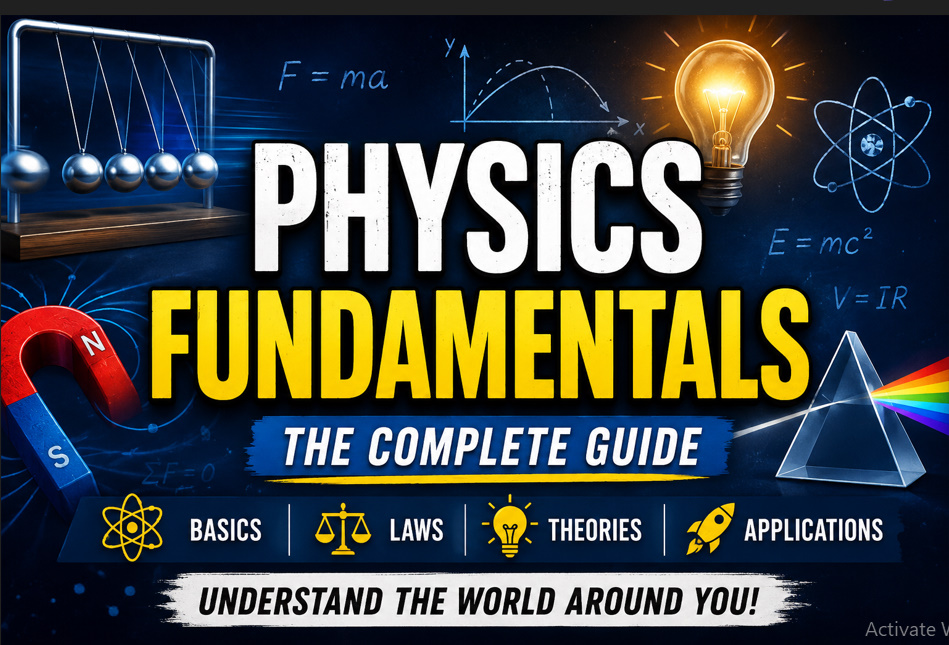
Physics Fundamentals: Exploring the Science That Shapes Our Universe
Physics is the science that helps us understand everything from the smallest particles to the largest galaxies. Every movement, force, sound, light beam, and electrical signal follows physical principles that scientists have studied for centuries. Whether you’re watching rain fall or using a mobile phone, physics is at work behind the scenes.
Mastering physics fundamentals gives students a solid scientific foundation and improves analytical thinking. Instead of memorizing facts, physics encourages learners to ask questions, investigate evidence, and understand why natural events happen the way they do.
Understanding the Foundation of Physics
Physics is the scientific study of matter, energy, motion, and the interactions between them. It seeks to explain natural events using observation, experimentation, and mathematical calculations. Every scientific invention relies on the principles discovered through physics.
The study of physics fundamentals begins with simple concepts like mass, force, distance, and time before moving toward advanced subjects. Building a strong understanding of these core ideas makes learning higher-level physics much easier.
Key Highlights
- Physics explains natural phenomena.
- Matter occupies space.
- Energy causes change.
- Motion occurs over time.
- Force changes movement.
- Measurements improve accuracy.
- Experiments verify ideas.
- Mathematics supports physics.
- Scientific models explain observations.
- Physics influences daily life.
Why Physics Matters in Everyday Life
Many people think physics exists only inside classrooms, but its applications surround us every day. From driving vehicles and charging smartphones to cooking food and watching television, physics makes modern life possible.
Understanding basic physics also helps people make better decisions, solve practical problems, and appreciate technological innovations. Engineers, doctors, architects, and computer scientists all rely heavily on physical principles.
Key Highlights
- Smartphones use physics.
- Cars depend on mechanics.
- Electricity powers homes.
- Medical imaging uses physics.
- Sports involve motion.
- Weather follows physical laws.
- Aircraft rely on aerodynamics.
- Satellites orbit Earth.
- Renewable energy uses physics.
- Technology advances through science.
The Main Branches of Physics
Physics has developed into numerous specialized fields that investigate different aspects of nature. Classical physics studies objects visible in everyday life, while modern physics focuses on microscopic particles and cosmic phenomena.
Important branches include mechanics, thermodynamics, optics, electromagnetism, quantum mechanics, astrophysics, particle physics, and nuclear physics. Each field contributes unique knowledge that benefits science and industry.
Key Highlights
- Mechanics studies movement.
- Thermodynamics examines heat.
- Optics focuses on light.
- Electromagnetism studies electric forces.
- Quantum mechanics explores atoms.
- Astrophysics investigates space.
- Nuclear physics studies atomic nuclei.
- Particle physics explores subatomic particles.
- Plasma physics studies ionized matter.
- Biophysics connects biology and physics.
Basic Physical Quantities and SI Units
Every scientific measurement requires standard units to ensure consistency worldwide. The International System of Units (SI) provides a universal language for scientists, engineers, and researchers.
Physical quantities are divided into base quantities and derived quantities. Accurate measurement allows scientists to compare experiments and make reliable predictions.
Key Highlights
- Length uses meters.
- Mass uses kilograms.
- Time uses seconds.
- Temperature uses kelvin.
- Electric current uses amperes.
- Force uses newtons.
- Energy uses joules.
- Pressure uses pascals.
- Power uses watts.
- Frequency uses hertz.
Motion and the Forces That Control It
Motion occurs whenever an object’s position changes relative to time. It may move in straight lines, circles, or complex paths depending on the forces acting upon it.
Forces are pushes or pulls that influence an object’s speed or direction. Gravity, friction, tension, and applied force are among the most common examples encountered in daily life.
Key Highlights
- Motion depends on reference points.
- Speed measures distance traveled.
- Velocity includes direction.
- Acceleration changes velocity.
- Gravity pulls downward.
- Friction slows movement.
- Balanced forces maintain motion.
- Unbalanced forces change motion.
- Mass affects acceleration.
- Force is measured in newtons.
Newton’s Laws and Fundamental Scientific Laws
Sir Isaac Newton introduced three famous laws of motion that transformed science forever. These laws explain why objects remain still, move, or accelerate under the influence of forces.
Besides Newton’s discoveries, physics includes several other important laws such as the Law of Conservation of Energy, Ohm’s Law, Hooke’s Law, and the Laws of Thermodynamics, each describing different physical processes.
Key Highlights
- Inertia resists change.
- Force equals mass times acceleration.
- Every action has a reaction.
- Energy cannot disappear.
- Electric current follows Ohm’s Law.
- Springs obey Hooke’s Law.
- Heat follows thermodynamics.
- Gravity attracts masses.
- Scientific laws predict outcomes.
- Experiments confirm laws.
Major Theories That Changed Physics
Scientific theories provide comprehensive explanations supported by evidence. They differ from simple guesses because they undergo repeated testing before being accepted.
Albert Einstein’s Theory of Relativity revolutionized our understanding of gravity and space-time, while Quantum Theory explains the behavior of particles at the atomic level. Together, these theories transformed modern science.
Key Highlights
- Relativity explains gravity.
- Quantum theory explains atoms.
- Scientific theories require evidence.
- Space and time are connected.
- Light has constant speed.
- Atoms contain tiny particles.
- Electrons behave like waves.
- Modern physics expands knowledge.
- Research continues worldwide.
- Theories evolve with evidence.
Energy, Heat, and Electricity
Energy exists in many forms including mechanical, thermal, electrical, chemical, and nuclear energy. Although energy changes form, the total amount remains constant according to the conservation law.
Electricity has become one of humanity’s greatest achievements. It powers industries, communication systems, transportation, healthcare equipment, and countless household appliances.
Key Highlights
- Energy changes forms.
- Heat transfers energy.
- Electricity moves electrons.
- Circuits control current.
- Batteries store energy.
- Generators produce electricity.
- Motors convert electrical energy.
- Solar panels capture sunlight.
- Wind turbines generate power.
- Efficient systems save energy.
How Physics Supports Modern Technology
Nearly every technological invention depends on physical principles. Computers process electrical signals, satellites communicate through electromagnetic waves, and medical equipment uses sophisticated physics-based techniques.
The continuous advancement of science ensures that physics remains central to innovation. New discoveries improve transportation, communication, healthcare, environmental protection, and space exploration.
Key Highlights
- Computers use electronics.
- GPS depends on satellites.
- MRI scanners use magnetism.
- Internet uses electromagnetic waves.
- Robotics applies mechanics.
- Artificial intelligence uses hardware.
- Spacecraft follow orbital physics.
- Renewable energy improves sustainability.
- Sensors detect physical changes.
- Engineering relies on physics.
Tips for Building Strong Physics Knowledge
Learning physics becomes easier when students focus on understanding concepts instead of memorizing formulas. Regular practice, solving numerical problems, and performing simple experiments strengthen scientific thinking.
A strong command of physics fundamentals prepares students for advanced courses in engineering, medicine, computer science, architecture, and research. Consistent study habits make complex topics easier to understand over time.
Key Highlights
- Study concepts first.
- Practice calculations regularly.
- Learn SI units.
- Understand formulas.
- Draw diagrams.
- Perform experiments safely.
- Solve real-life problems.
- Review scientific laws.
- Ask questions often.
- Stay curious about science.
Conclusion
Physics is a powerful science that explains how the universe functions through measurable principles and proven scientific laws. By learning the basics, exploring major branches, understanding important theories, and applying physical concepts to everyday life, students develop valuable analytical and problem-solving skills. A solid understanding of physics fundamentals provides the confidence needed to explore advanced scientific topics, pursue STEM careers, and better understand the technology that shapes our modern world.