
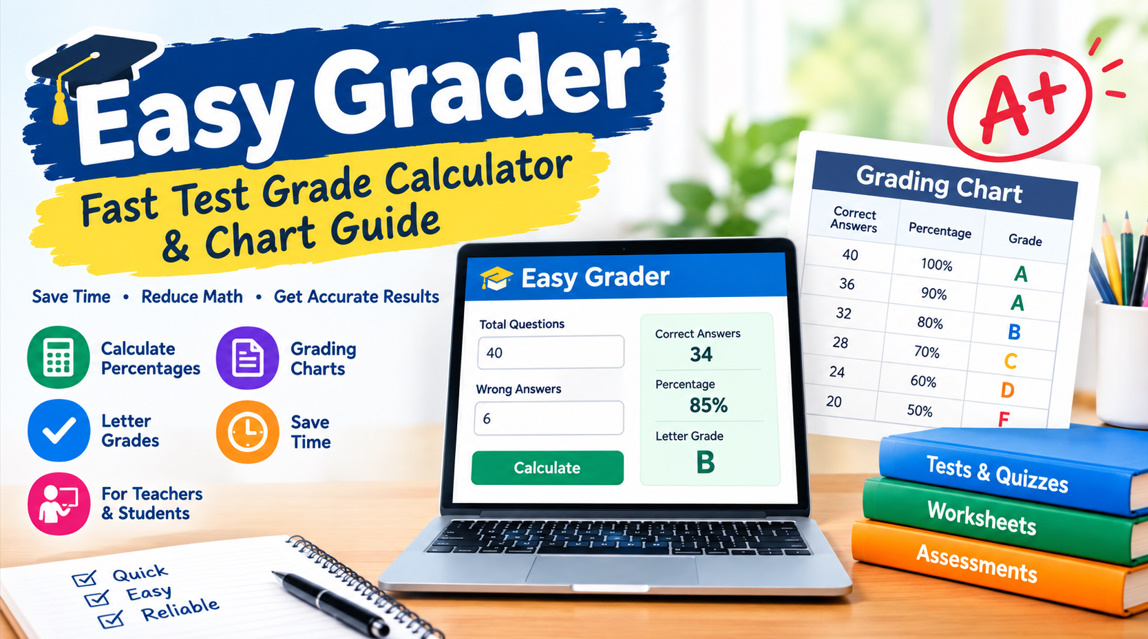
What Is Easy Grader?
Easy Grader is a simple grading calculator designed to make test and quiz scoring faster. Instead of calculating percentages manually, teachers or students can enter the total number of questions and incorrect answers. The tool determines correct answers, percentage scores, and corresponding letter grades with minimal effort.
The concept behind an easy grader is straightforward: calculate the number of correct responses, convert that number into a percentage, and match the result with a grading scale. This makes it useful for classroom tests, quizzes, worksheets, homework assessments, and other activities where questions carry equal value.
- Online grade calculator
- EZ Grader tool
- Test score calculator
- Quiz grading helper
- Percentage calculator
- Letter grade converter
- Teacher grading tool
- Student score checker
How Does an Easy Grader Work?
An Easy Grader generally requires two basic values: the total number of questions and the number of questions answered incorrectly. The number correct is found by subtracting wrong answers from total questions. The percentage is then calculated from the correct answers and total questions.
For example, if a quiz contains 20 questions and a student misses 3, the student has 17 correct answers. Dividing 17 by 20 and multiplying by 100 produces an 85% score. The final percentage can then be matched against the grading scale used by the school or instructor.
- Enter total questions
- Add incorrect answers
- Calculate correct answers
- Find the percentage
- Check the letter grade
- Review the grading scale
- Verify the result
- Record the score
Easy Grader Formula Explained
The Easy Grader formula is based on a basic percentage calculation. First, subtract the number of wrong answers from the total number of questions. Next, divide the correct answers by the total questions and multiply by 100. This produces the student’s percentage score without requiring complicated mathematical calculations.
The formula is particularly useful when teachers need to understand how a score was produced. For instance, a 25-question test with 4 incorrect responses has 21 correct answers. The calculation is 21 ÷ 25 × 100, resulting in 84%. The letter grade depends on the selected grading policy.
- Correct = Total − Wrong
- Percentage = Correct ÷ Total
- Multiply by 100
- Count errors carefully
- Check total questions
- Avoid duplicate entries
- Review decimal results
- Apply the correct scale
Why Teachers Use Easy Grader
Grading a large number of papers can become repetitive, particularly when every student completes the same assessment. An easy grading calculator reduces repeated arithmetic by providing a consistent method for converting raw scores into percentages. Teachers can focus more attention on reviewing student work and providing useful feedback.
A grading chart can also make classroom assessment more convenient. Once the total number of questions is known, teachers can quickly determine how different numbers of incorrect answers affect the final percentage. This can be especially helpful when grading quizzes, multiple-choice tests, and short classroom assessments.
- Saves grading time
- Reduces arithmetic work
- Supports consistent scoring
- Simplifies percentage calculations
- Helps organize grades
- Useful for repeated tests
- Makes score checking easier
- Supports classroom efficiency
Easy Grader for Students
Students can also use an Easy Grader to understand test results. By entering the number of questions and mistakes, they can calculate their approximate percentage and understand how individual errors affected the overall score. This can make percentage grades easier to interpret.
An online grade calculator can also help students check manual calculations. If a student already knows the number of correct answers, the percentage formula provides a quick way to verify the result. However, the official grade should always follow the grading policy established by the teacher or school.
- Check test percentages
- Understand raw scores
- Verify calculations
- Learn percentage conversion
- Review missed questions
- Estimate score ranges
- Understand letter grades
- Track assessment results
Easy Grader and Different Grading Scales
Not every school uses exactly the same grading scale. A common system may classify 90% and above as an A, 80–89% as a B, 70–79% as a C, and so on. However, individual schools, teachers, courses, and institutions can establish different boundaries, plus-minus grades, or passing requirements.
For that reason, an Easy Grader should be used together with the applicable grading policy. A percentage calculation is mathematical, while the letter grade is determined by the grading scale. Checking the correct scale prevents confusion when a percentage could receive different letter grades under different academic systems.
- Standard grading scale
- Plus-minus grading
- Custom grade boundaries
- Passing percentage
- Percentage ranges
- Letter grade conversion
- Course grading policy
- Institutional requirements
Easy Grader for Different Test Sizes
One advantage of a digital grading calculator is its flexibility with different test sizes. A teacher may need to grade a short 10-question quiz one day and a 50-question examination another day. The same basic formula works for both, although each incorrect answer has a different percentage impact.
For a 10-question test, one mistake represents 10 percentage points. On a 50-question test, one mistake represents only 2 percentage points. This difference shows why raw scores should be converted into percentages before comparing assessments with different numbers of questions.
- 5-question quizzes
- 10-question tests
- 15-question assessments
- 20-question quizzes
- 25-question tests
- 50-question exams
- 100-question assessments
- Variable test sizes
Tips for Accurate Easy Grading
Accurate grading begins with accurate input. Before calculating a score, confirm the total number of questions and count incorrect responses carefully. If an assessment includes bonus questions, partial credit, weighted sections, or questions with different point values, a basic question-count calculator may not represent the complete final grade.
It is also important to distinguish a test score from an overall course grade. An Easy Grader is most suitable for assessments where questions have equal or clearly defined values. For weighted assignments, cumulative averages, or course-level calculations, additional grading information may be required.
- Count questions carefully
- Verify wrong answers
- Check partial credit
- Review bonus points
- Confirm grading rules
- Use the correct scale
- Recheck unusual scores
- Keep grading records organized