
What Is a Flames Calculator?
A Flames Calculator is a digital version of the traditional FLAMES name-matching game. It compares two names by removing matching letters, counting the letters left, and applying a circular elimination process. The final remaining letter corresponds to one of several playful relationship categories.
The game is commonly associated with school-age entertainment and has been adapted into online calculators that perform the counting automatically. Because the process depends on the letters entered rather than personality or behavior, its result should be viewed as entertainment rather than a genuine compatibility assessment.
- Digital version of FLAMES
- Uses two names
- Matches letters
- Counts leftovers
- Applies elimination
- Produces one result
- Easy to understand
- Designed for fun
What Does FLAMES Stand For?
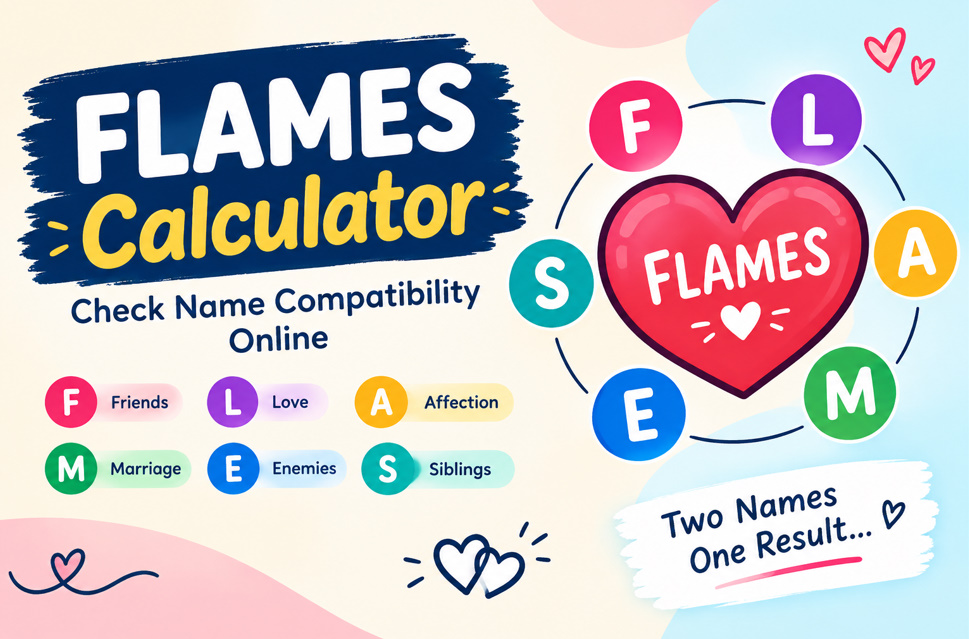
The word FLAMES is an acronym. A common traditional version uses F for Friends, L for Love, A for Affection, M for Marriage, E for Enemies, and S for Siblings. Some modern versions use a different interpretation for S, such as Soulmates.
These categories give the calculator its familiar relationship theme. The meanings are part of the game’s tradition rather than scientifically established relationship classifications. Different calculators can therefore use slightly different descriptions while following a similar name-counting concept.
- F means Friends
- L means Love
- A means Affection
- M means Marriage
- E means Enemies
- S often means Siblings
- Some use Soulmates
- Meanings can vary
How Does a Flames Calculator Work?
The basic FLAMES calculation begins with two names. Matching letters are cancelled on a one-to-one basis, and the remaining letters from both names are counted. That total becomes the number used during the next stage of the traditional elimination method.
Next, the calculator works through F-L-A-M-E-S in a circular pattern. A letter is eliminated according to the remaining-letter count, and counting continues with the letters still available. The process repeats until one letter remains, which becomes the final FLAMES result.
- Enter two names
- Compare letters
- Cancel matches
- Count leftovers
- Write FLAMES
- Count around the letters
- Remove one at a time
- Reveal the survivor
How to Calculate FLAMES Manually
To play the classic game without a digital tool, write the two names separately and compare their letters. Cancel matching letters one at a time rather than removing every occurrence automatically. Then add together the letters that remain in both names. This produces the number used for elimination.
After obtaining the total, write F-L-A-M-E-S and begin counting around the sequence. Remove the letter where the count ends, then continue from the next available letter. Repeat the process until only one letter remains. That letter identifies the traditional relationship category.
- Write both names
- Compare matching letters
- Cancel pairs
- Count unmatched letters
- Create FLAMES
- Count sequentially
- Continue after removals
- Keep the final letter
Understanding the Six FLAMES Results
Each surviving letter represents a playful category. Friends generally describes a platonic connection, while Love represents the game’s romantic category. Affection refers to warmth or fondness, and Marriage is traditionally associated with a long-term relationship. These descriptions are symbolic rather than scientific findings.
Enemies represents the game’s rivalry-oriented category, while Siblings describes a family-like connection in many traditional versions. Some newer versions replace or reinterpret S as Soulmates. Because there are multiple versions of FLAMES, users may encounter different labels depending on the calculator they use.
- Friends
- Love
- Affection
- Marriage
- Enemies
- Siblings
- Soulmates in some versions
- One final category
Why Can Different Flames Calculators Give Different Results?
Different FLAMES calculators may use slightly different rules. One calculator might use first names only, while another could accept full names. Some versions also handle spaces, punctuation, duplicate letters, or the letter S differently. These implementation choices can affect the remaining-letter count and ultimately the final result.
The counting procedure can also vary between versions. For example, calculators may differ in how they continue counting after an elimination. Therefore, if two tools produce different answers for the same names, the difference does not necessarily mean one calculation is malfunctioning; they may simply follow different FLAMES rules.
- Different name formats
- First names only
- Full names
- Duplicate-letter handling
- Different S meanings
- Counting variations
- Different elimination rules
- Tool-specific algorithms
Is the Flames Calculator Accurate?
A Flames Calculator can be consistent when it follows a fixed algorithm: entering the same names under the same rules should generally produce the same result. However, consistency is different from scientific accuracy. The game does not measure personality, communication, shared values, or other evidence-based relationship factors.
For that reason, a FLAMES result should not be treated as a prediction of what will happen in a real relationship. It is better understood as a lighthearted name-matching game. Real relationships involve personal choices, communication, mutual respect, experiences, and many factors that a letter-counting game cannot measure.
- Consistent calculation
- Not scientific evidence
- Based on names
- Uses letter patterns
- No personality analysis
- No psychological testing
- No guaranteed prediction
- Mainly entertainment
Tips for Using a Flames Calculator
For a clearer result, enter names consistently and check the spelling before calculating. If you want to compare results from different calculators, use exactly the same names and formatting. This helps determine whether a difference comes from the calculator’s algorithm rather than from different inputs.
It can also be interesting to try a nickname and then a full name, but remember that changing the letters can change the mathematical result. Most importantly, treat the outcome as a lighthearted activity rather than a basis for making important decisions about friendships or relationships.
- Check spelling
- Use consistent names
- Avoid accidental spaces
- Compare the same inputs
- Understand the rules
- Try manual calculation
- Expect different implementations
- Enjoy the result casually